

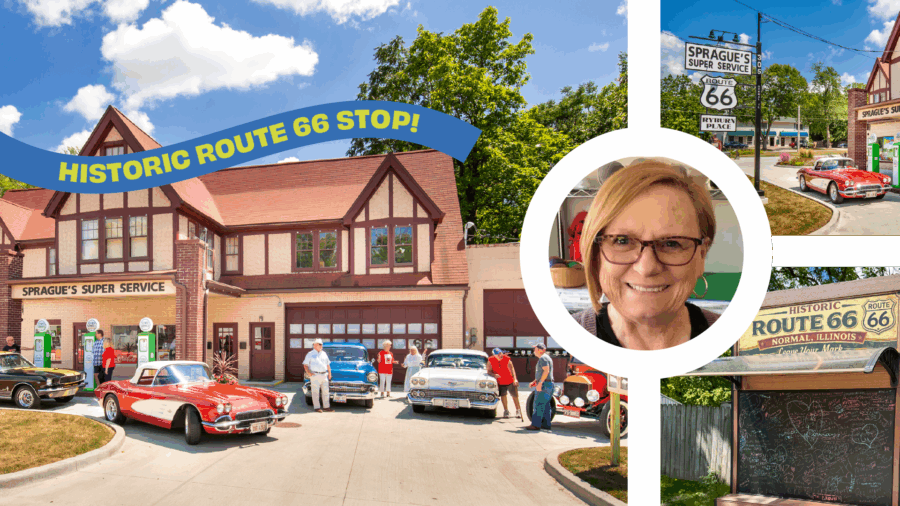
As we celebrate the Route 66 Centennial in 2026, we’re highlighting the places and people that make McLean County an essential stop along America’s Mother Road. Throughout the year, this 12-part blog series will spotlight iconic Route 66 locations and feature conversations with the mayors of our Route 66 communities, each sharing their own stories, history, and vision for the future. This installment marks 6 of 12 posts in the series, starting a journey that honors our past while inviting visitors to experience what makes our stretch of Route 66 unforgettable. Buckle up – there’s a lot of road left to explore!
 Though taken for granted on modern road trips, the fuel stations established along the Mother Road became part of the legend themselves, employing many of the same charming tactics to lure motorists in for a few minutes of rest and quick, convenient refueling.
Shortly after Route 66 was commissioned, William W. Sprague saw an opportunity to lure transcontinental travelers off the Mother Road, brief as their stop may be. But where other stations at the time relied on brand loyalty — be it to Sinclair, Texaco, or Standard Oil — Sprague took a different approach when he constructed Sprague’s Super Service in 1931. Housed in a two-story Tudor Revival-style building, the station welcomed visitors to town with what the National Park Service describes as a “local, homey identity” that rebelled against the corporate architecture of the era.
“Sprague was very forward-thinking. He was an entrepreneur, and he thought about what people needed when they traveled,” said Terri Ryburn, owner of Ryburn Place Gifts & Gab, which occupies Sprague’s elegant building today. “He built the building with a café, which was very unusual in 1931. The next room was the office for the gas station and the garage, so he could sell car parts, tires, oil, fan belts… Whatever you needed for your car. And then, of course, he pumped gas out front. The attached two-bay garage had pits in the floor so the mechanic could get up under the cars and work on them. Upstairs, he built two apartments, one for him and his wife and a small one above the garage for the mechanic or the attendant. Very smart to have everybody live right on-site, and it took a lot of guts for a man to build something this grand during the Depression.”
The station operated until the 1970s, when the tanks were removed and the original pumps sold off. Numerous businesses rented the space throughout the years, including a bridal shop, a photography studio, and a computer repair business. But by the mid-2000s, time had taken its toll on the building. Ryburn — who has held a lifelong fascination with Route 66 and even wrote her dissertation on the subject — wished someone would rescue the building. So, when the building went on the market, she jumped at the opportunity.
“I’d never been in the building, and I was just dying to get inside and look,” Ryburn explained. “So, my real estate agent met me over here, opened the door, and I said out loud, ‘What kind of a crazy person would buy a dump like this?’ So, that’s me.”
A decade of hard work brought Ryburn’s station back to its former glory. In 2016, the Town of Normal purchased the building and both parties worked together to have the station listed on the National Register of Historic Places, ensuring today’s Route 66 travelers can experience Sprague’s Super Service like vacationers did 90-plus years ago — and bring home a keepsake and a story from Ryburn Place.
“Sprague’s Super Service has always been just a grand entrance or exit for folks. It’s one of the first buildings people encountered when they came into town, and the last when they left,” Ryburn said. “Normal has so few places left from that time or prior to that, so this is a very important landmark. I’ve noticed that since this building started being restored, there’s been a bit more pride among homeowners. Today, they point to Sprague’s as a magnificent building, and they tell people where they live in relation to the station. It’s kind of become a point of pride for the neighborhood and for the town.”