

As we celebrate the Route 66 Centennial in 2026, we’re highlighting the places and people that make McLean County an essential stop along America’s Mother Road. Throughout the year, this 12-part blog series will spotlight iconic Route 66 locations and feature conversations with the mayors of our Route 66 communities, each sharing their own stories, history, and vision for the future. This installment marks 4 of 12 posts in the series, starting a journey that honors our past while inviting visitors to experience what makes our stretch of Route 66 unforgettable. Buckle up – there’s a lot of road left to explore!
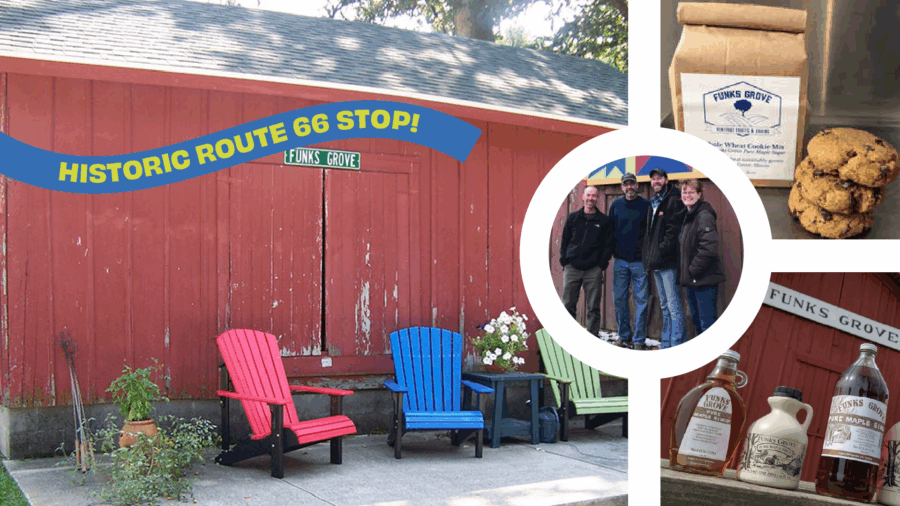
 If you’re exploring Historic Route 66 near Bloomington-Normal, a sweet stop awaits just off the Mother Road. Nestled in the countryside near Shirley, Funks Grove has been producing its signature maple sirup using time-honored techniques for generations, offering visitors a taste of history that dates back to the early 1800s. This story, originally featured in our 2026 Visitor Guide, highlights a family tradition rooted in craftsmanship, curiosity, and a deep connection to the land. From tree tapping to tasting, it’s a Route 66 experience that’s as rich in flavor as it is in heritage.
Any respectable eatery serving breakfast keeps a jar of maple-flavored goodness on hand. Drizzled over pancakes, waffles, or French toast, maple sirup (or “syrup,” to the uninitiated) is a staple condiment at the breakfast table, but its history in North America dates back thousands of years before the first European settlers arrived. For generations, Native Americans were known to harvest maple sugar to season their vegetables and drizzle maple sirup over their meat and fish. So, after Isaac Funk came upon a piece of land near Shirley that was rich in timber, water, and soil, he too was drawn to the sweet extract waiting to be tapped.
“When Isaac Funk settled here in 1824, he and his sons began tapping the trees and would boil it all the way down to make maple sugar,” explained Debby Funk, who, along with her husband Mike, great-great-grandson of Isaac Funk, has helmed Funks Grove since 1988. “Pure maple sirup was first sold as a commercial product at Funks Grove in 1891.”
Funks Grove Maple Sirup, officially named by Isaac Holmes’s granddaughter, Hazel Funk Holmes, in 1926, follows the same time-honored techniques employed by the Funk family in the 19th century — more or less. Sugar maple trees are still tapped in late winter, during which the water-like sap is collected and boiled, evaporating much of the moisture and concentrating the sugar. The evaporation process has changed considerably since the Native Americans dropped hot coals directly into the sap. Today, Funks Grove utilizes modern evaporators that use reverse osmosis to concentrate the sap before it’s even evaporated, conserving fuel and time. Funks Grove even welcomes guests to get an up- close look at their proprietary methods — and to bring home some sweet, maple-based treats for themselves.
“We offer tours to groups and individuals showing the process of making maple sirup at our farm,” Debby said. “We walk out to the trees and explain the tapping process, then go into the sugarhouse where the evaporator is located and show the boiling process.”
So, why is it spelled “sirup”? Contemporary producers conflate the two into the spelling with a “Y,” but for many years, the words were differentiated not just by a single letter but also by how they were prepared. Funks Grove Pure Maple Sirup insists on the original spelling not as a semantic matter, but out of family tradition. “Hazel Funk Holmes, who established a perpetual trust for the property, insisted on the ‘I’ spelling because when Webster’s dictionary was first published, there were two different definitions for the words ‘sirup’ and ‘syrup,’” Debby explained. “Webster defined ‘sirup’ as the product of boiling sap, while ‘syrup’ was defined as the product of adding sugar to fruit juice. While most sirup producers today use the ‘Y’ spelling, we continue the tradition of the ‘I’ spelling per Hazel’s wishes.”